Adaptive Riding

At TEAD, adaptive riding is an inclusive, participant-centred recreational program designed to ensure that individuals of all abilities can safely experience the joy, connection, and benefits of working with horses.  Using an inclusive, compassionate, and professional approach, our CanTRA-certified instructors help individuals with disabilities learn how to ride a horse using adaptive teaching methods and / or specialized equipment.   Each lesson is tailored to meet the unique strengths and needs of each participant, and encourages deep, unforgettable connections with their horses, fellow riders, staff members, and volunteers.  Every ride promotes a sense of community, fulfillment, personal growth, and most of all – fun!

Riding has many benefits including (but not limited to):

  • Development and improvement of balance & coordination
  • Mobilization of trunk & pelvis
  • Improvement of muscle tone & strength
  • Prevention of contractures
  • Increased confidence & self-esteem
  • Increased concentration, motivation & patience
  • Improved learning skills
  • Improvement of social integration
  • Access to recreation, sport and/or competition
  • A sense of control that might not otherwise be felt in everyday life

Lesson Fees (8 to 12-week commitment)

  • Assessment: $45, one-time only before registration
  • Private lessons: $125 each for 45 minutes (1 rider)
  • Semi-private lessons: $100 each for 45 minutes (2 riders)
  • Group lessons: $75 each for 60 minutes (3 or 4 riders)
  • Annual membership fee: $15

 *Riding lessons are a recreational activity and not a therapy, therefore are not billable under most insurance plans.*
How to Get Started

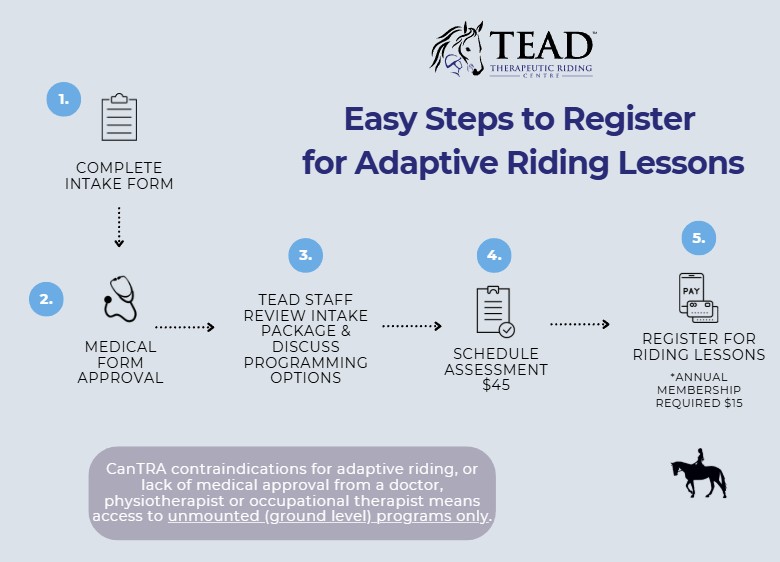
The intake process for our adaptive riding program is simple and straightforward.

  1. Fill out an intake form, and click on the navy blue ‘Register’ button. We use Amilia SmartRec for assessment, adaptive riding, grooming, and summer camp registration.  If you are having difficulty navigating the site, contact troton@tead.on.ca or view their online help centre.
  1. Our staff will be in touch about your goals, appropriate program options, and next steps once the intake form is submitted. You will also be provided with a medical form for the participant’s doctor to fill out and sign.
  1. Once received, the intake & medical forms will be reviewed by our occupational therapist, riding instructors, and office staff to ensure individuals with medical conditions can safely be supported to ride.

*If riding is not medically approved, unmounted programs are available to support a wide variety of goals.   Please view the below for all contraindications for horse riding noted by CanTRA (the Canadian Therapeutic Riding Association).  For more information on our grooming programs, click here.*

  1. Next, an assessment will be conducted by one of our CanTRA- certified instructors to ensure appropriate supports, and individualization of equipment, programming and goals.

Once a date and time have been decided, you will be sent a link to sign up for an assessment. Each assessment includes:

    • Tour of the barn, arena & tack room
    • Meeting some of our horses
    • Fitting a helmet
    • Balance & coordination assessment mounted on our mechanical horse
    • Determining any equipment and / or volunteer supports needed for lessons
    • Determining a suitable horse(s)
  1. Afterwards, the applicant will be able to register for lesson spots online when they become available.

Our Program Resource Administrator can assist with every step of this process.  Email troton@tead.on.ca for any assistance. We look forward to welcoming you on the farm.

Contraindications to
Adaptive Riding

The following diagnoses represent contraindications to adaptive horseback riding as stated by CanTRA.  Please note whether these conditions are present and to what degree in your medical form package:

ORTHOPAEDIC

  • Acute arthritis
  • Acute herniated disc or prolapsed disc
  • Atlanto-axial instabilities
  • Coax arthrosis (degeneration of hip joint)
  • Structural cranial deficits
  • Osteogenesis imperfecta
  • Pathological fractures
  • Spondylolisthesis
  • Structural scoliosis >30 degrees, excessive kyphosis or lordosis or hemivertebra
  • Spinal stenosis
  • Hip subluxation, dislocation or dysplasia (one hip)

NEUROLOGICAL

  • CVA secondary to unclipped aneurysm or angioma
  • Paralysis due to spinal cord injury above T6 (adult)
  • Spina bifida associations – Chiari II malformations, hydromyelia, tethered cord
  • Uncontrolled seizures within the last 6 months while on medication, or 12 months not on medication

OTHER

  • >170 lbs
  • Age under 2 years old

READY TO TAKE THE NEXT STEP?

Our team is here to help you explore programs and find the right path forward.